


The Friends of Enfield Chase is a group formed to look after the Enfield Chase project.
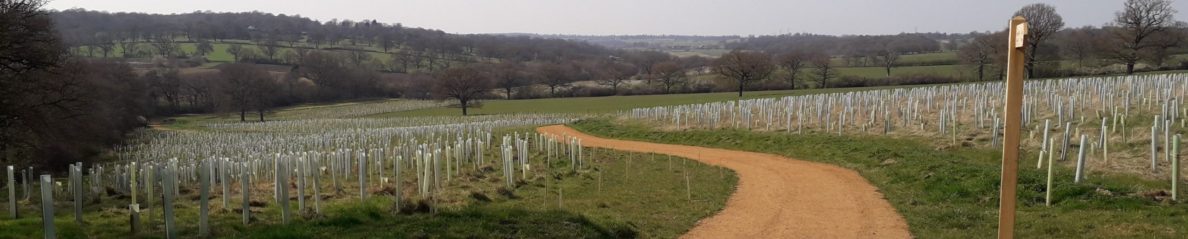
With the help of volunteers, Enfield Council planted over 100,000 trees on the outskirts of Enfield. A common question is often, ‘It’s all well and good planting them, but who’s going to look after them?’, and the answer is us! Enfield Council employs a woodland development officer to ensure the woodland successfully grows to maturity, and the Friends of Enfield Chase support him through volunteering our time. As an independent group we can also have a voice with the council to ensure the public users of the woodland get a say, and we can ensure the woodland stays a benefit to us all.
We meet regularly to do practical conservation in the site, and this can include repairing broken stakes and guards, or surveying the health of the trees and surrounding vegetation.
If you’re interested in helping out, watch out for our events and join in, or simply contact us.

Chair’s Report – Year Ended 30th September 2026
During the year, the Friends of Enfield Chase continued to support
the development of the “Chase” through practical conservation
work, community involvement and emerging citizen science
activities.
With more than 1,600 volunteer hours contributed by
FOEC volunteers alone, the “Friends” remain an essential part of
efforts to establish resilient woodlands, restore habitats and
encourage local people to connect with this expanding public
landscape.
Looking ahead, tree planting at New Cottage Farm and
progress on wider landscape and river restoration initiatives offer
further opportunities to support nature recovery.
Tuesday Volunteering
The “Friends” have continued their practical work to help establish
and maintain the developing woodlands, wetlands and wildlife
habitats of Enfield Chase. Working alongside Enfield Council’s
woodland and nature recovery staff, James and Andrew, the
“Friends” have contributed more than 1,600 volunteer hours during
the year.
Activities included checking the health of young trees, repairing
stakes and guards, replacing failed saplings where appropriate,
removing weeds and litter, and maintaining habitats. Volunteers
also created deadwood habitats and raptor perches, walked fence
lines to identify and repair gaps, and cleared willow growth from
field paths. The removed material has been reused for dead hedges
and a willow circle. A twigloo added another feature to the
developing landscape. Last winter saw more than 8,000 trees planted.
The exceptionally hot summer brought its challenges, but volunteers continued
working, including mulching young trees to help retain moisture.
The August bake, bring-and-share gathering provided a welcome
opportunity to share food and a good chat alongside the practical
work.
Borehole monitoring continued, and Thames21 managed citizen
science activities began in June. New information panels and maps
are helping visitors understand the changing landscape. The
“Friends” practical experience and growing knowledge of the site
remain important to its long-term success, while regular activity
encourages local ownership and connection with nature.
Enfield Chase Landscape Recovery Project
October 2025 saw the completion of the Eastern Gateway
Woodland Creation Project, marked by a celebratory walk, cycle
ride and planting event involving schoolchildren, councillors,
community groups and volunteers.
The £1 million project helped deliver the ambition of increased
publicly accessible woodland, by creating more than 3.4 kilometres
of new and improved footpaths and cycleways. Features to manage
water naturally were also incorporated, supporting the wider aims of
landscape recovery and climate resilience.
In January 2026, Enfield Council’s Cabinet considered proposals for
a long-term funding agreement with Defra to support continued
habitat restoration, public access and natural flood management.
The Council’s team are working hard to sign a 20 plus year
agreement with Defra expected soon!
Salmons Brook Restoration
The proposed restoration aims to improve three kilometres of river
and floodplain habitat, return the river to a more natural state, and
create new wetlands and woodland. This will help reduce flood risk
to around 2,000 homes in Edmonton while providing a shared
space for nature, wellbeing and the local community.
Citizen science is an important part of this ambition. Monitoring
opportunities include Riverfly surveys to assess aquatic
invertebrates, physical habitat surveys, water quality testing,
environmental DNA (eDNA) sampling to detect species, and soil
sampling. Together, these activities can build a clearer picture of
river health and the effectiveness of restoration work, while enabling
local people to contribute directly to the evidence base.
Thames21 conducted some MoRPh training in October. This will
help monitor the incredible changes in the river’s geomorphology
over time, and provide vital data for this ground breaking scheme.
The construction for the first phase of works started in August and
will continue until weather permits. Volunteers helped secure
deadwood in the floodplain to encourage the dynamic and complex
natural processes of the river. It’s finally out of it’s old, over
deepened channel. The Council is hoping to celebrate this
milestone at an event on Saturday 5th December – details to follow.
Looking Ahead
This year’s tree planting will take place at New Cottage Farm. The
aim is to increase biodiversity and establish a wildlife corridor and
shelterbelt alongside the M25, using a mixture of native tree
saplings.
Some previously planted trees failed to establish following the hot
summer and will need replacing. This process, known in forestry as
“beating up”, is a normal part of woodland establishment.
The Friends of Enfield Chase will continue to play their part in
helping Enfield Chase develop into a thriving, accessible landscape
for wildlife and people alike.
Well done everyone, a fantastic year.
John Cole
October 2026